
As a manager or leader, it can be difficult to decide on what you want to achieve, whether it’s for yourself or with a group of people. Setting targets for a whole team can be even trickier because there are so many factors to take into account. This comprehensive guide will help you understand how to set achievable and measurable organizational goals for your team. With our tips and strategies, you’ll be on your way to success in no time!
What are employee goals?
Employee goals are specific objectives that an individual employee aims to achieve within a certain period of time in order to contribute to their organization’s overall success. Setting specific, measurable and achievable objectives for employees that align with your overall company mission is crucial for success. By doing so, everyone in your team is working toward the same outcome, ensuring that everyone is contributing their best efforts to achieve your organization’s goals. This approach helps each person understand their contribution and how they fit into the bigger picture. Moreover, it creates a sense of value in every team member, resulting in the organization’s success.
Why are employee goals important?
Employee goals are like a roadmap for your team, showing them the direction they need to take to accomplish their tasks and fulfill their responsibilities. For people, they can:
- Provide direction and focus
- Help everyone prioritize their work and stay motivated
- Give a sense of purpose and accomplishment when achieved
Goals don’t just help individual team members—they can also help the whole organization move toward success. Helping people achieve their objectives can help organizations:
- Align individual efforts with organizational objectives
- Increase productivity and success by having everyone work toward the same objective
- Ensure that everyone is contributing to the success of the big picture
- Improve tracking and measurement of progress
- Provide a framework for performance reviews and feedback
However, while your team’s input is crucial, your leadership team needs to be involved in decision-making. Let’s say you’re launching a new product to increase sales, and your team has suggested some strategies. Leaders should work with team members to develop the skills and knowledge they need to execute on the chosen strategy. This way, you’re enabling your team to contribute to the organization’s success while still supporting the decision-making process.
Examples of employee goals.
Setting SMART goals—which are goals that are specific, measurable, achievable, relevant and time-bound—provides motivation and accountability while identifying and overcoming any obstacles that may arise. Specific objectives will naturally depend on your organization and your team members’ roles but to help you get started, here are some examples of strategic goals:
- Improving customer satisfaction or retention rates
- Increasing sales revenue or profit margins
- Expanding market share or entering new markets
- Enhancing product or service quality
- Streamlining operational efficiency or reducing costs
- Fostering innovation or introducing new products/services
- Investing in employee development or improving talent retention
- Enhancing brand reputation or increasing brand awareness
- Adapting to changing industry trends or regulations.
Benefits of goal setting for employees.
Creating solid objectives can offer many advantages for organizations, regardless of their size or industry. Let’s take a look at some of these benefits to fully understand the importance of managers dedicating time to this meaningful practice.
Easily conduct performance reviews
When you set employee development goals, you create a clear framework for tracking progress and evaluating performance based on objective criteria. Performance reviews are a crucial part of evaluating progress and giving feedback, and setting goals can make this process easier for everyone. Setting goals can help streamline performance reviews and make them more effective by:
- Using clear criteria for performance evaluation can make it easier for you to assess progress
- Providing meaningful feedback to help your team improve performance and achieve objectives
- Providing efficient processes to save you time and increase your productivity
- Improving morale by recognizing and evaluating your team members for their efforts, which can lead to increased job satisfaction
Efficiently plan across the organization.
Segmenting your goals can be a helpful approach to ensure that all areas are aligned and working toward a common mission. By breaking down larger objectives into smaller, more specific ones, you can make progress toward your goals more manageable and measurable. You can segment goals for your team by:
- Department. Ensure every area contributes to success. For example, the marketing department can aim to increase website traffic by a certain percentage, while sales can aim to boost revenue by a specific amount.
- Team. Try to improve collaboration and ensure everyone works toward the same objectives. For instance, a project team can work together to complete a project within a set timeframe or achieve a specific outcome.
- Individual. Help your team members focus on professional development, so they can make a positive impact. This can mean helping them enhance their public speaking skills or learn a new software program.
Motivate and recognize the team.
When you provide individual employees with clear expectations and give them the necessary support to achieve their goals, it can increase their motivation and productivity. Here are some practical strategies you can use to motivate and incentivize your team:
- Set clear, challenging goals. Challenge them with objectives that align with your organization to increase motivation and engagement.
- Provide regular feedback. Help them stay on track through constructive feedback so they can continue to meet objectives.
- Recognize progress. Regular recognition can motivate them to succeed for themselves and the organization.
- Offer opportunities for professional development. Boost your team’s growth and development by providing them with access to professional workshops and webinars.
- Foster a positive organizational culture. A positive environment where your team feels valued will lead to increased productivity and job satisfaction.
Increase retention and overall job satisfaction.
When your team has a clear understanding of expectations, it can lead to a greater sense of job satisfaction and loyalty to the organization. This, in turn, can result in enhanced employee performance and encourage longer tenures. Here are some key benefits of increasing retention and overall job satisfaction by setting clear expectations:
- Lower turnover costs. Boosting employee retention rates by clarifying expectations can help your organization save on recruitment and training costs, ultimately leading to increased financial stability and success.
- Improve customer service. Engaged and satisfied team members are more likely to provide excellent customer service, resulting in happy and loyal customers.
- Increase profitability. When employees are engaged and motivated, they tend to work toward achieving goals and objectives, which can ultimately lead to increased profitability and growth over time.
Enhance alignment and communication.
Effective alignment and communication can have a significant impact on organizational performance and satisfaction. Here are some of the benefits of enhancing alignment and communication for your employees:
- Increase engagement and motivation. Your team is more likely to be engaged and motivated to perform their best when they understand how their work contributes to the big picture. Employee performance can increase 22% when employee goals align with organizational values.
- Improve teamwork. Your team is more likely to collaborate with others.
- Enhance performance and productivity. When everyone works toward the same objective, it can lead to an overall better job performance.
5 ways managers can help employees achieve their goals.
Simply establishing achievable goals is not enough; you must also support your teammates in achieving them. Luckily, there are many effective strategies you can use to provide that support including:
1. Regularly discuss performance objectives.
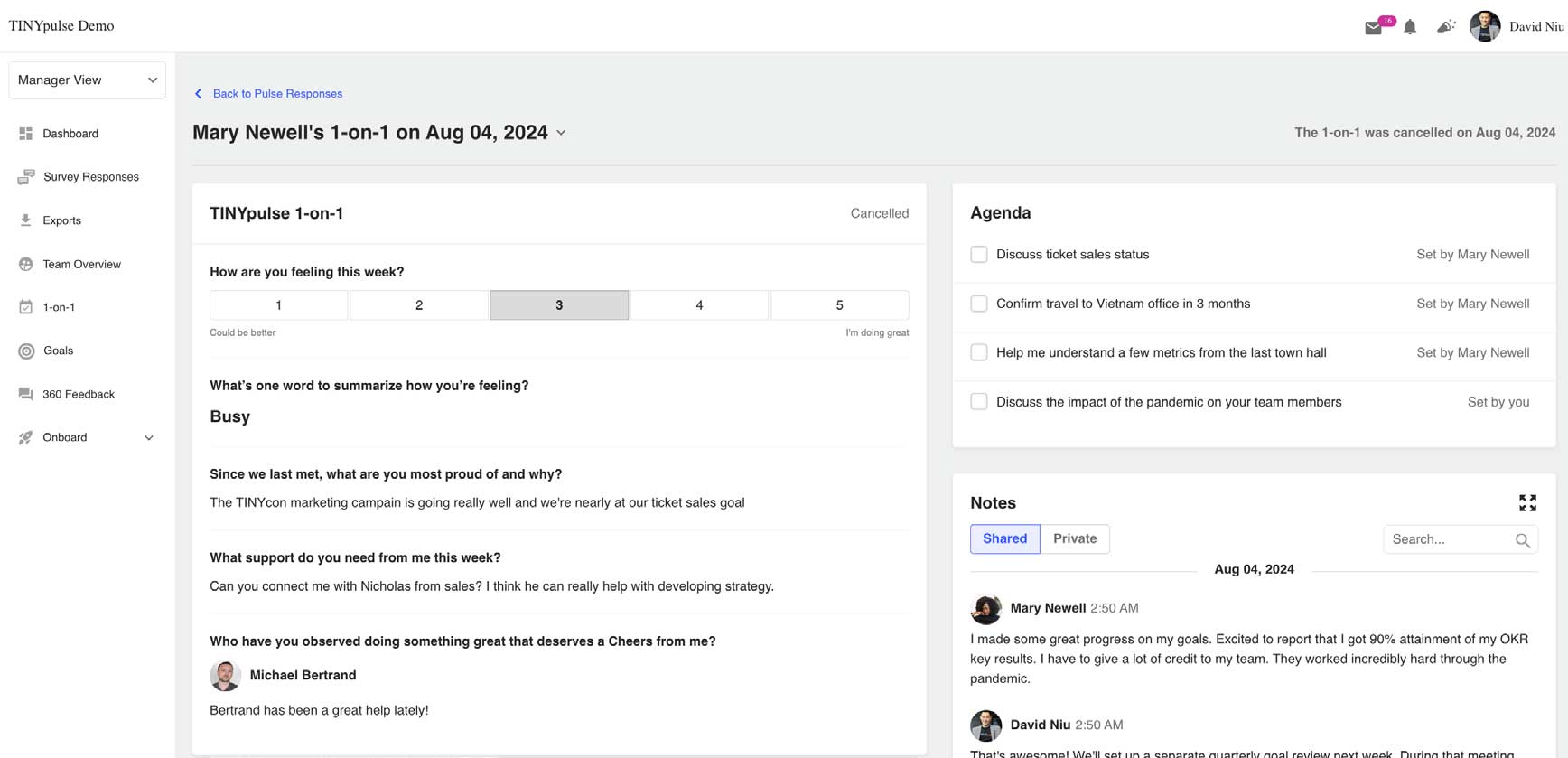
Regular 1:1 meetings are important to foster effective communication and growth within your team. Furthermore, employees are 3 times more likely to be engaged if they have weekly manager check-ins. These meetings should be a safe space for you and your team members to share feedback and ideas, and to identify growth opportunities. Take the time to check in on how everyone is feeling about their job and use their feedback to set new objectives and work collaboratively toward meaningful and challenging future plans. By keeping open lines of communication, you can help your team grow and develop, setting your organization up for long-term success.
2. Empower everyone to measure personal growth.
Encouraging your team to pursue their passions can create a more fulfilling and purpose-driven work environment, leading to increased motivation and commitment. By incorporating their personal and professional goals into their career development plans, you can create a culture of continuous growth and learning that gives employees a sense of belonging. As highlighted by the Integrated Benefits Institute research, employees who feel a sense of belonging are 3.4 times more likely to be physically healthy, 5.2 times more likely to be socially health and 4.4 times more likely to be mentally healthy.
3. Offer opportunities for career development and professional growth.
To create a culture of growth and engagement, you can identify opportunities for career advancement. Providing job shadowing, training programs and mentorship can help your team members plan for success. You can set long-term development goals to help your employees see the big picture and understand how their contributions fit into the overall strategy. Additionally, offering stretch assignments with new challenges and responsibilities can encourage engagement, create a sense of purpose and direction and increase job satisfaction and retention. This approach will keep your team members motivated and excited about their work, leading to a more productive and successful environment.
4. Support employees who want to pursue new roles at your organization.
To boost your employees’ satisfaction, productivity and retention, it’s important to encourage internal mobility. By fostering a culture that values and supports internal mobility, you can create a more dynamic and skilled workforce. One way to promote this is by establishing an easy-to-use internal job search site and communicating it through various channels. As a manager, you can offer guidance and support throughout the application process to help your team members succeed. By supporting your employees’ career development, you can build a more capable and resilient workforce that is more likely to stay with your team for the long-term.
5. Offer career coaching.
Offering career coaching to your team can be an effective way to support their professional growth and development. Providing access to a mentoring program or discounted sessions with a certified career coach demonstrates that you value your team’s career aspirations and are committed to their professional success. By working with a coach, your team members can identify their strengths, explore new career paths and develop new skills, leading to greater job satisfaction and productivity. Additionally, coaching can provide fresh perspectives and help your team overcome obstacles and challenges.
Improve performance and drive employee development.
Establishing clear goals is essential for nurturing a culture of growth and development within your organization. Building high-performing, motivated teams starts with encouraging open and constructive dialogue between managers and employees. Coach, by TINYpulse, simplifies 1-on-1 meetings by enabling meaningful conversations and effortless documentation of coaching sessions. With integrated 360-degree feedback for well-rounded assessments, Coach ensures personal goals align with company objectives, driving continuous improvement and engagement at every level. To discover how Coach can transform your team’s communication and goal setting, reach out to our sales team at [email protected] or request a demo today.